Friday, March 10, 2017

Teaching English in Kasba Peth


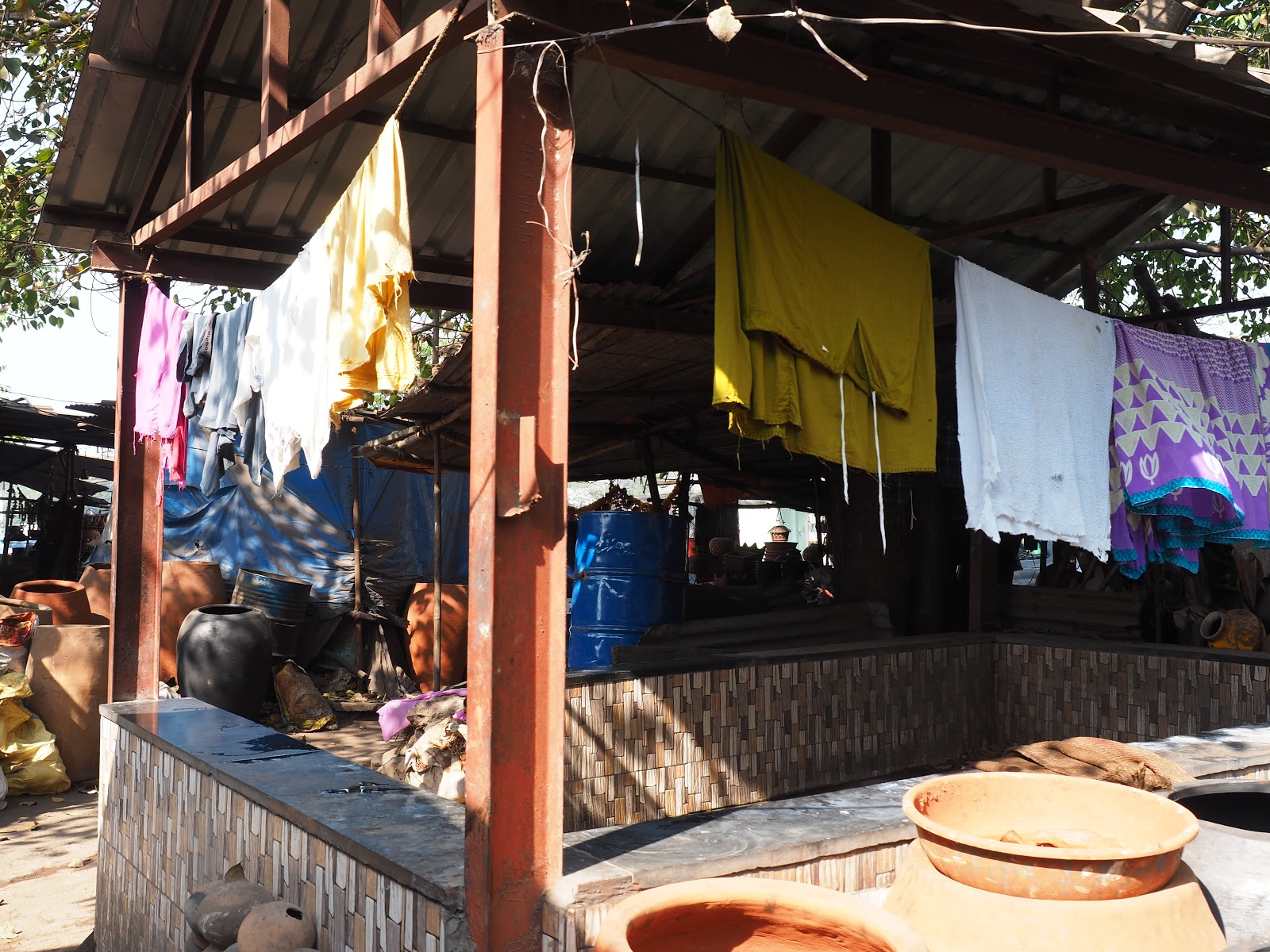
The communal wash area.
The women feel vulnerable to be photographed while washing
I taught English today, in Kasba Peth, the original settlement in Pune.  Kasba Peth is the oldest residential part, or Peth, in Pune.  It was established sometime during the 5th century and is close to the historic ShaniwarWada palace-fort, in the heart of Pune city.  It is actually known as is the “Heart of Pune City,” and I feel very fortunate to have have landed a volunteer teaching gig here.


Kasba Peth is primarily residential, and is well known for the Kumbhar Wada (area of earthen potmakers) and the Tambat Ali (area of brass/copper utensil and pot makers).  As you walk through Kasba Peth you can here the rhythmic pounding of the copper as the copper-men pound out the pots.


They let my kids have a go when we first visited.


It was much harder than Gracie expected.

Even George struggled a bit.

The man's granddaughter was with him that day and she had a little pot to bang-learning Grandpa's trade.  She let Gracie have a go.


I was really nervous about my first day teaching and almost chickened out.  But my sister, on call in the OR, sent encouraging words to me and I swallowed my fear and I went.  I entered the Peth through a narrow walkway lined with piles of black earthen pots, and entered the residential area near the communal wash area where the women all come together to wash clothing and cookware.  I was pleased that I managed to find the small temple without any problems, and then I just hoped the women would come.  I greeted all I met with a nod and Namaste, and was greeted kindly in return.  I removed my shoes, entered the small temple and organized my supplies.


I had 4 students. They speak Marathi and a small amount of Hindi.  And it is not easy to teach a second language to someone when you don't know their first language.  But they come, and they smile and giggle and we try to understand each other. Of the four women, there are four very different skill levels.  And often it is hard to tell if they understand me, as, in the Indian way, they nod pleasantly in the affirmative, whether they understand or not.


I feel so blessed to have had this role practically thrown into my lap.  I'd been looking for some volunteer work, something where I could use my skills to give something to India.


From the time I learned about the possibility of an assignment in India I knew I wanted to not live only a stereotypical expat lifestyle. I wanted to integrate, at least in some small ways.  We chose a home in a society with very few expats, and now none other than us.  But upon moving I discovered that even that would keep us very apart from the average Indian, for the divide between the very rich and the poor is vast here, and suddenly we were seen part of the very rich.

We have help here.  Wonderful people who we really care for, indeed love.  But they will not use my name-I am and will remain Madam or mam.  I have to refer to my husband as sir, or they wonder who I am talking about.  So we are not integrating.


see the tree growing out of the building?


When my mom was here visiting, we went took a Chalo Heritage Tour, guided by a wonderful man named Rashid.  The tour began at Kasba Peth.  Rashid and his wife have worked to establish a good working relationship with the people of Kasba Peth so that he can bring his tours through.  People are encouraged to take photos, especially of the people if they are willing (and many are).  Rashid then asks you to send him your photos, which he prints and brings to the people of Kasba Peth.  Many here had never seen, let alone owned, a photo of themselves or their children.  So they do love having pictures and it has encouraged a lovely relationship between the people of Kasba Peth, the tour guides and the tourists, and that relationship is not monetary.


On our tour, Rashid mentioned that there was a woman who came and taught English to some residents of Kasba and that the relationship had grown organically out of his tour.  I realized I knew the women he was talking about, and the next time I saw her I asked to volunteer with her and help her teach.  When she learned I had formerly taught English as a Second Language, she was thrilled to have me.  I joined her one time to teach and was very excited to join her weekly.  But then her husband was offered new work and they decided to relocate to the UK.  So she reached out and said, will you take it over?  And that is how I am now the English teacher in Kasba Peth.  Weekly I teach a young MBA student for an hour, then the local printer and yoga master (not quite a yogi, but 10th level?) for an hour, often accompanied by his two sons.  Then I teach a group of women in the Peth’s Hindi temple.  The number of women vary week to week, but there are 4 that come most weeks.


So I’ve gone from feeling like I would never integrate, to being quite warmly welcomed into Pune’s oldest residential neighborhood.  It is a remarkable place.  Rashid tells the story of a young mother who had a 2 year old daughter and was having twin girls.  When it came close to time to give birth, this young mother left her 2 year old daughter in the Peth and went to her village to have the twins.  She was gone several weeks.  And each time Rashid walked though the Peth, he saw her young daughter, with different hairstyle and different make-up, happily playing.  She was cared for by a different family each night and all the families took care of her.  All I could think was how very blessed all of these people were for this kind of support system.  And to make it even more wonderful, perhaps exceptional, and certainly exceptional to someone from the west, is this Peth is mixed, both Hindu and Muslim.  So the little Muslim girl was cared for, with respect for her faith, by both Muslims and Hindus, so her mother could leave her without a worry.


The printer I teach has a printing press.  He only prints straight lines, for lined paper.  He was asked once by a tourist why he didn’t expand his business.  He took time to consider this question.  Then he explained that he had enough to support his family, and enough time to do what he and they enjoyed.  So he didn’t see why he should expand, for then he would not have time to enjoy life.  I believe this is a lesson the west has forgotten.  We are taught to strive for more and more, and rarely taught to stop and appreciate what we have. 


Now everytime I enter Kasba Peth, I am greeted by smiling faces, or smiling eyes behind hijabs.  I am greeted with Namaste or hello and I hear them greeting each other with Namaste to Hindus and As-salamu alaykum to Muslims, as the Muslims and Hindus greet each other respectfully with the proper greeting for the receiver’s faith.  And there is always a smile to be passed on.  What a lovely place.


Thursday, February 9, 2017

It Only Hurts So Much Because There is so Much Love


We just said goodbye to my Mom and Finn, our first visitors from home and, well, my Mom.  I can’t express how good it was to have my Mama here.  For the first time in my life I’m living someplace that people simply cannot imagine if they haven’t been here.  And it felt so good to be able to share it with my Mom, to have someone see where we live and what our life here is like.  Somehow I found deep comfort in that. 

Mom has never wanted to visit India.  It was hard to convince her to come.  At first she said she wasn’t going to, and I was crushed.  I told her I was crushed, and she made it happen.  Then I was so nervous to have them.  I was worried that it would be hard on them to be here and that the travel would be too hard.  Getting around here is also hard.  But Mom was amazing!  She saw beauty everywhere, even where I just still often can’t see past the dust and the dirt.  She was in awe of the different ways people live and she simply absorbed everything.  They weathered a 6 hour car ride to Aurangabad to visit some ancient caves and temples, and she stayed with the kids so I could run out in a strange city to find a new hotel and arrange lodging for my driver after our first arrangement proved inhabitable.  She rode all over the city, visited George’s far away school 3 times and both of Grace and Alex’s even more.


I’ve never traveled with my Mom outside the United States, and have always known she was a strong woman.  I should have realized how adventurous she really was, after all she and Dad had done some really interesting travel, like taking an old Russian fishing boat as a cruise through the South Pacific, and exploring China for a month.  Finn was not so adventurous, and really disliked being in the car (it is no fun) for long periods, and is not an adventurous eater.  Luckily he enjoyed our house and terraces so much that he was happy just staying home.  So Mom and I went out a lot just the two of us (plus Sushil, my driver).  I don’t think I could count the times each day Mom said, “Your dad would have loved this” or “Your dad would have wanted to paint everything here.”  There is such comfort to be found in hearing mom talk about Dad and miss him, and want to share experiences with him still, even as she has found such joy and love with Finn.


I often feel Dad here with me.  It’s funny that in a place so different from anything I ever experienced with him, I feel him with me so much.  I think it’s because life is harder for me here, and often lonelier.  Dad was always there for me, so I bring him with me even still.  So much of the scenery here, I can actually feel him aching to paint it.  I want to share it with him like I did with mom.  I have to believe that I am sharing it with him, every time I feel him with me.

The other day I had a very painful morning.  Alexander and Grace have changed school because the 2 hour round trip commute to their last school was beginning to take a terrible toll, especially on Alexander.  So we started the new school and I was worried that it might not work for Alexander-he had the best teacher at his last school, someone who just saw his brilliance and his beauty and reveled in his difference.  Grace and Alex went two days to the new school, then we went on a road trip and missed four days, then they started again on Monday.  Their new teacher, Pinky, was trying so hard to welcome us, and to please me, that she was exuberant in her welcome.  She tried so hard to include Alex that she was leaving all the other students to come up to us, where Alex was struggling with me leaving, and she got in between us to ask him to join, and just was loud and close and pushy-in a way that works great for Grace and for lots of other kids, but is REALLY wrong for Alex.  I asked her to give us some space and to give him some time, but she just didn’t get it.  I took him, crying, into the hallway to cuddle and talk.  Every minute someone would come interrupt us to ask, “What happened?!”  They really don’t like kids to cry here.  I sat with him and did some exercises, tipping him quickly upside down and then having him pull himself up.  This helps regulate him and had him laughing, until Pinky came out into the hall to try to get him to come in and join them.  

I finally did leave him there, crying, but I was a wreck, so worried he’d be a complete mess that night when he got home to the safety of me.  My heart hurt, the way only a Mom’s heart can when she is worried about her child.  I stopped by the Principals office to explain my fear and let her know I wasn’t sure this school would work for Alex.  And I cried-which made me mad.  She assured me she’d make it work, and we scheduled a meeting for us and the teacher, but I left the school frightened, upset, and worried, with a big crack in my heart.  I cried all the way home and was so thankful to get home and get a big hug from my mom.  She’s read everything I’ve pointed her to, to help her understand autism and Alexander, and she is so supportive now.  So I got my hug, we got in the car and headed out to visit an outdoor market.  I started crying again in the car and suddenly I felt Dad there with me, his arm around my shoulder, giving me a squeeze, saying, “Ahh, honey” in that way that made me know how much he cared, even if he didn’t fully understand.
 

So today as I say goodbye to my Mom, I remind myself of the lesson I learned when my Dad died-that it only hurts so much because there is so much love.  And I give thanks that I have so much love, no matter how far away it may be.

Monday, February 6, 2017

Pimpri Market


When my Mom was visiting, she took everything in with wide open eyes.  I was in awe of her ability, at age 76, to come here and view everything in awe.  She saw the beauty and the color where I have often struggled to see past the dirt and the poverty.  Balu also saw her openminded awe and loved taking her out to show her around.  On her second to last day here, he took us to the market where he shops for his food for his family.  

Can you pick her out of the crowd?


I've often been told I needed to experience Mandai Market and Shivaji market, but we live on the other side of town and it is an excursion to get over there.  It doesn't seem like it should be, because it's about 14 kilometers away.  But in Pune, that's at least 45 minutes and often an hour and a half.  So it's fine for a visit, but not for regular shopping.  But Pimpri Market is about 15 minutes from our house and it is the real deal.  I don't speak any Marathi, so Balu comes with me, but my novice Hindi helps a bit and they're always amazed I speak any-though I'm finding most vendors speak only Marathi.

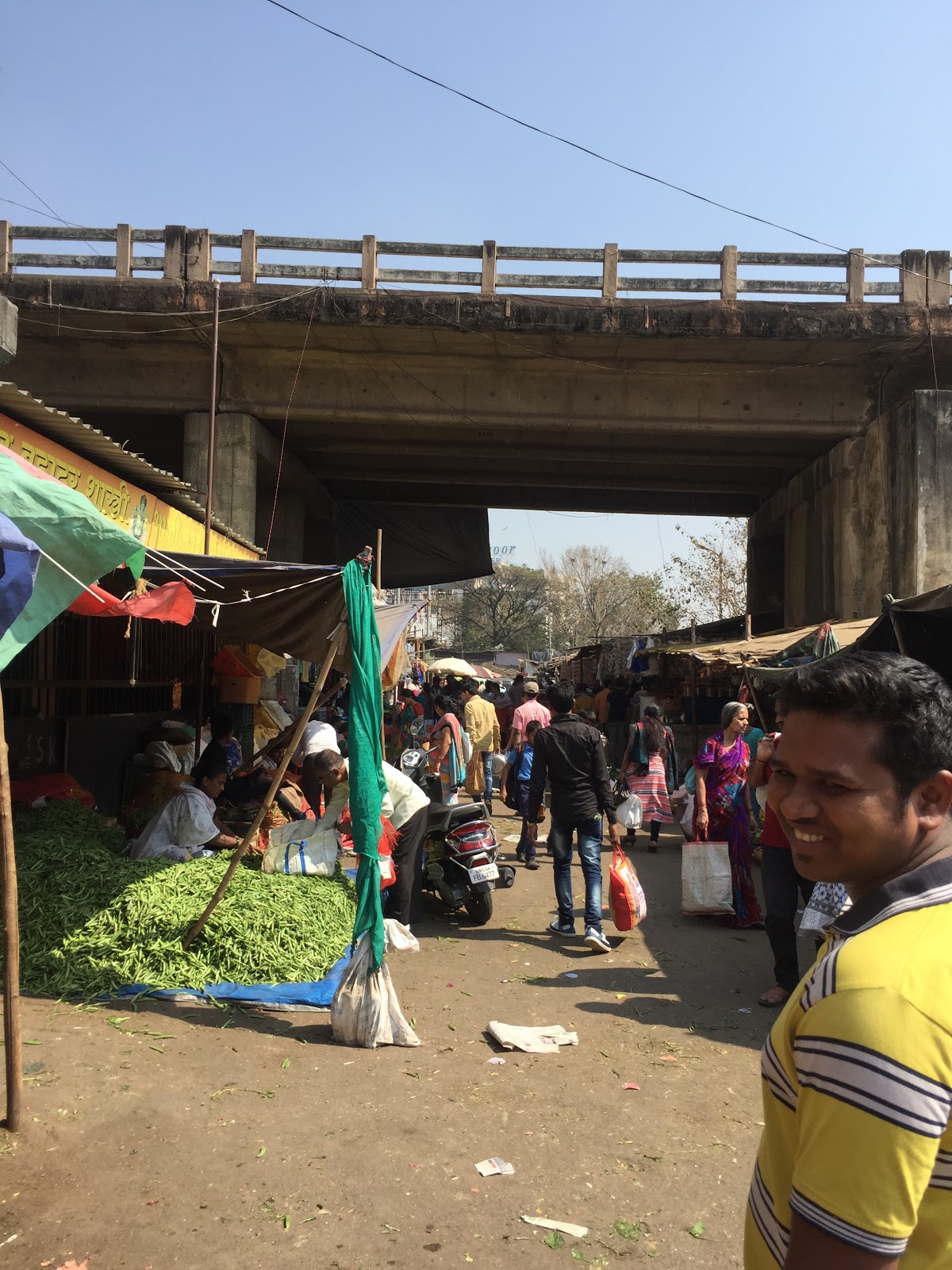
I instantly fell in love with Pimpri Market, and Mom declared it the best thing she'd seen in India.  It is huge.  It's under and around a huge overpass.  There are hundreds of stalls selling fresh vegetables and fruit, dried fish, chilis, spices and herbs.  Everything is so beautiful and fresh, or freshly dried and fragrant.  Have you ever smelled a guava?  When they are ripe, they overpower everything with their sweet, floral scent.  Mix this with cilantro (coriander), masala, incense and smoke, body odor and fish, smoke and diesel, flowers, and hot oil and fried food from the street food vendors and you have the scents of India.  Waft a bit of sewage and rotting garbage through it all and it's a complete experience (luckily those last scents waft through but don't often stay for long).


Grace and I adore figs and they are so sweet and fresh and flavorful here.  The green fruit next to the figs are guava.

Look at the varitey-eggplant (these tiny colored ones have a bit of a bite like horseradish), green mango, beans, bitter gourd, okra (bindi or lady fingers), tomatoes and some zucchini like vegetable that is used in sambar (my favorite Indian breakfast). 


These are 1 to 3 feet long and called drumsticks.  They are also used in sambar.

More varities of dried fish than I could identiy

It's strawberry season here.  Outside the Dorabjees in camp they charge 400 rupees a kilo.  Here, about 100.  That's aout $1.50, and they're so sweet.  Notice the long thumb nail on the man?  Most men here have that.  I asked Balu why and he said he does it because he likes the way it looks.  His long nail was his pinky.

I, sadly, did not bring my good camera that day.  And my iPhone just could not capture the size of the market.  In the picture below, if you look closely, you can see that the stalls run down about as far as you can see.  It's like that in every direction.  It seems impossible that there could be a market for this much produce.  After all, it's in the 80s to 90s every day and things spoil really, really quickly.  But then you take your mind outside into the traffic (or even stop staring at the produce and realize how crowded it is right where you're standing) and the hustle and bustle of teeming humanity, and remember that there are millions of people to feed right here in Pune.  Many millions.  


Look at this bounty!  And the pride each vendor takes in his or her display.  Everything is artfully arranged and maintained and rearraged as people sort through the piles.  Many people call out to you as you pass, advertising what they have and that it's the best today, the freshest, the best price.  I can't understand a lot of what they are calling, and yet I can.  It's like you absorb the understanding through your skin, and inhale it like smoke.  The vendors and shoppers are also diverse with Muslim stands right next to Hindi stands, all sharing the same chai from the same wallah, peacefully and happily coexisting and even supporting each other.  I'm sure there are many other religions mixed in, but you can assume Hindi and identify Muslims and Sikhs from their headwear.  Pimpr market, like so much of India, exemplifies religious choice as bountiful and acceptable as the produce.

Next Monday I'll try to get better pictures of the scales.  They are wonderful old scales that they counter with old iron weights.


The stalls have aisles on each side where smaller displays are set up, and then there are alleys and by-ways selling spices and decorations, jewelry and colored powders.  The backside aisles seem to contain more ginger, turmeric (the root), garlic, onions and potatoes-things that don't make you draw your breath in awe at the colors, but which make your food taste like the bounty looks-rich, diverse, full of flavor.  I'm quite sure you could get everything you need to live right in and around this market.


As always in India, I'm nearly struck dumb by the electricity and the wiring.  It's amazing and confounding to see.  I've watched men work with the wires and seen them just cut the plug part off the wire, strip the wires, then plug the raw, exposed wires directly into the outlet.  The wires connect this way and that, like a non-geometric spider's web.  If someone wants power and doesn't have it, they may well just strip a bit of someone else's wire away and attach their wire directly to it.  Problem solved.  But who's electricity bill covers it?

Drinking his chai.

I always ask before I photograph people (unless I'm cruising past in the car).  I think it is the respectful thing to do.  And I honor it when they say no, or when I cannot be sure they said yes.  But it's hard to get the candid shot.  This young man had just receieved his tea from the chai wallah and was settling in to drink it.  His pose is exactly the same as it had been before he saw me, but the direct and cheeky expression in his eyes has certainly changed.  As it's a look I often see as I'm stared at wherever I go, I am glad I missed the candid shot and captured a bit of my reality instead.  Look into his eyes.  He's looking directly at me, staring.  There is a bit of wonder and a lot of amusement in his look, and a bit of a challenge too.  


This little boy was working with his family, selling the "popcorn."

When you decide you want to buy something, they'll often hand you a big, battered aluminum bowl.  You choose what you want and hand it back to be weighed.  Some vendors want to choose for you, but I often find these are the ones who will sneak in a rotting berry or battered cucumber.  Others insist you taste their apples, mangoes, strawberries and oranges before you buy.  Either way it's far better than buying the plastic wrapped produce at the expat stores where you can't get close to any of it.  Plus, it's about 20% of the price here at the open market than outside at the stores.


The side aisles in the market are largely dried things, especially spices and fish.  I think the fist stalls are fascinating.  They have the tiny dried fish in addition to large steaks cured and dried in salt that you just pan cook,  It's an ancient way to preserve meat without refrigeration, but it's quite new to me.


Look at the large steaks to his right.  There is white fish and red fish.  I don't know the variety, but he handed me some to hold and examine and I was sorely tempted to buy some, but not courageous enough to try it.

Look at the variety.  The pink is shrimp.  He even has eggs.  I do wonder what you use the dogfish (shark) for.


  The market is surrounded by narrow, densely populated alleyways that are packed with small shops selling clothes, shoes, ornaments, fabric, electronics, sewing machines(often man powered) and more.  It's overwhelming to the senses with the hustle and bustle and hawkers and children and ever present dogs combined with the languid walk of the men and the quiet repose of the women waiting on customers.  Again, the contrasts of India: where everything is teeming and fast and loud, and everything is languid and unhurried, seemingly all at the same time.


Very few electric sewing machines, which makes sense because even if you do have electric power where you live, you lose it often.

See the flames next to the woman in purple?  She is toating chana (or chickpeas) to sell as a snack.  The greenery surrounding her is the plants she is plucking the peas freshly from.  A chickpea straight from the plant is so different and wonderful from what we are used to in the west, dried or canned.  They're green and tender and full of flavor and nutrition.  We have a field of them near our bungalow and the local children munch them as a snack all season.